
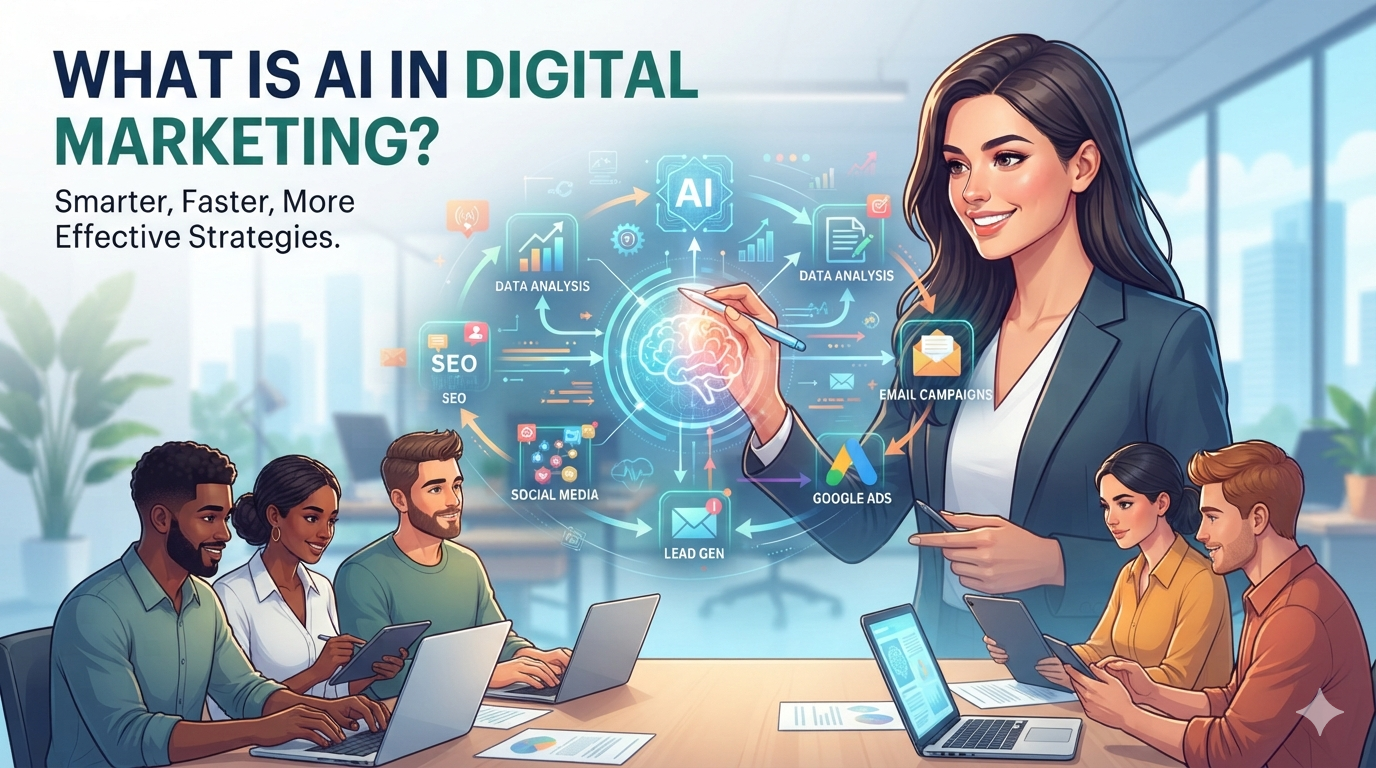
AI IN DIGITAL MARKETING
AI in Digital Marketing: How Artificial Intelligence Is Transforming Marketing in 2026 AI in Digital Marketing is changing how businesses attract customers, create content, run advertising campaigns, analyze data, and build long-term customer relationships. From automated content creation to AI-powered advertising and personalized customer experiences, artificial intelligence is becoming an important part of modern marketing strategies.For businesses, AI is not simply about replacing manual work. It can help marketers understand customer intent, make faster decisions, automate repetitive tasks, and deliver more relevant experiences at scale. Google’s current marketing guidance also highlights AI’s growing role in search, advertising, creative production, measurement, and customer journeys.
What Is AI in Digital Marketing?
AI in digital marketing refers to the use of artificial intelligence and machine learning technologies to improve marketing activities.AI systems can analyze large amounts of data, identify patterns, predict customer behavior, generate content, automate workflows, and help marketers optimize campaigns.For example, AI can help a digital marketer:Find relevant keywords and search trendsGenerate content ideasCreate advertising copyAnalyze customer behaviorPersonalize marketing messagesOptimize Google Ads campaignsAutomate repetitive marketing tasksIdentify potential customersPredict campaign performanceImprove customer support through AI chatbotsThe goal is not to remove human creativity from marketing. Instead, AI can give marketers more time to focus on strategy, creativity, relationships, and business growth.
1. AI-Powered Content Creation
Generative AI can help marketers create first drafts of blog posts, social media captions, email ideas, advertising copy, product descriptions, and video concepts.However, AI-generated content should not simply be published without review. Human marketers should check facts, originality, brand voice, accuracy, and usefulness before publishing.A strong approach is:AI for speed + Human expertise for quality.Google has also highlighted how generative AI can help marketers create and adapt creative assets at greater scale.
2. AI and SEO
AI is changing SEO by helping marketers understand search intent, identify content opportunities, analyze competitors, organize topics, and improve content.Modern SEO is increasingly about answering users' questions clearly rather than simply repeating keywords.Businesses should focus on:Helpful and original contentStrong topical coverageSearch intentClear headingsInternal linkingStructured informationFirst-hand expertiseUser experienceTrust and credibilityGoogle's 2026 marketing guidance also points toward the importance of authoritative, people-first content as search becomes more conversational and AI-powered.
3.AI-Powered Google Ads
AI is playing a major role in paid advertising.Google Ads uses AI-powered systems for areas such as bidding, targeting, creative optimization, and campaign performance. Smart Bidding, for example, uses machine learning to optimize bids at auction time based on conversion and contextual signals.AI can help marketers:Optimize bidsDiscover valuable audiencesMatch ads with relevant searchesGenerate or customize ad assetsIdentify performance patternsImprove campaign efficiencyGoogle's newer AI-powered Search solutions are also designed to adapt advertising to changing user behavior and search intent.
4. Personalization
Customers expect brands to understand their needs.AI can analyze customer interactions and behavioral signals to help businesses provide more relevant recommendations, messages, offers, and content.For example, an e-commerce company can use customer behavior to recommend products based on previous browsing or purchasing activity.Personalization can make marketing communication more relevant instead of sending the same message to every customer.
5. Predictive Analytics
One of the biggest advantages of AI is its ability to identify patterns in large datasets.Marketers can use predictive analytics to understand:Which customers are more likely to convertWhich products may generate higher demandWhich campaigns are performing wellWhich customers may stop engagingWhich audiences could provide future growthThis allows businesses to move from simply analyzing what happened to making better-informed decisions about what could happen next.
6.AI Chatbots and Customer Support
AI-powered chatbots can interact with customers 24/7.They can help answer common questions, provide product information, collect leads, schedule appointments, and guide users toward relevant products or services.For businesses, this can reduce response time and allow human teams to focus on more complex customer requirements.However, businesses should provide an option to connect with a human when the customer's issue requires empathy, judgment, or specialized assistance.
7.Social Media Marketing
AI can support social media marketing by helping marketers:
.Generate content ideas
.Write captions
.Analyze engagement
.Identify trends
.Repurpose content
.Develop creative concepts
.Understand audience interests
.Schedule repetitive workflows
How Businesses Can Start Using AI in Marketing
Businesses do not need to automate everything immediately.A practical approach is:
Type your paragraph here